China Dropshipping Service Providers: A Complete Comparison Guide
China remains one of the world's most important sourcing and fulfillment hubs for dropshipping. Its manufacturing network, supplier ecosystem, logistics infrastructure, and access to platforms such as 1688 make it possible for ecommerce sellers to source a wide range of products and ship them to customers around the world.
However, choosing a China dropshipping service provider is no longer simply about finding the lowest product price. A provider may help with sourcing but offer limited fulfillment capabilities, while another may combine procurement, quality control, warehousing, branded packaging, order synchronization, and international shipping in one system.
The right choice also depends on where your business is today. A beginner testing products has different requirements from a store processing hundreds of daily orders, while a brand that needs custom packaging or private labeling requires a different supply-chain setup again.
This guide compares several well-known dropshipping service providers and platforms available to ecommerce sellers in 2026. Rather than declaring one company the best for everyone, we will look at their different service models, strengths, limitations, and the types of sellers they may suit.
If you are still learning how the overall model works, our guide to the dropshipping business model explains how suppliers, sellers, fulfillment partners, inventory, and customer orders fit together.
What Is a China Dropshipping Service Provider?
A China dropshipping service provider helps ecommerce sellers source, process, and ship products from China. Depending on the company, its role may range from simply connecting sellers with suppliers to managing a large part of the supply chain.
Some providers operate large online platforms with product catalogs and automated store integrations. Others work more like sourcing agents, finding products from factories or Chinese marketplaces according to individual seller requirements. Fulfillment-focused providers may concentrate on receiving inventory, storing products, packing customer orders, and arranging international delivery.
This distinction matters because two companies described as “dropshipping providers” may offer very different services.
For example, a beginner may primarily need easy product importing and automated ordering. A growing brand may care more about supplier negotiation, quality inspection, custom packaging, inventory management, and reliable shipping.
Understanding these differences makes it easier to compare providers based on what your business actually needs rather than simply comparing their advertised product prices.
China Dropshipping Agent vs. Supplier: What’s the Difference?
The terms supplier and dropshipping agent are often used interchangeably, but they usually describe different roles.
What Does a Dropshipping Supplier Do?
A supplier provides the physical product. It may be a manufacturer, factory, wholesaler, distributor, or trading company.
Some suppliers can process individual customer orders and ship internationally. Others are primarily designed for wholesale transactions and expect buyers to purchase larger quantities.
Working directly with a supplier can reduce the number of intermediaries in the supply chain, but the seller may need to handle more supplier communication, quality control, shipping coordination, and order management independently.
What Does a China Dropshipping Agent Do?
A dropshipping agent typically acts as a coordinator between the ecommerce seller and one or more suppliers.
Instead of requiring the seller to find and communicate with every factory independently, a product sourcing agent may help source products, compare quotations, purchase inventory, inspect goods, consolidate products, manage packaging, and arrange international fulfillment.
This can become particularly useful when a store sells products from several different factories. Products can be sent to one warehouse before being combined into customer orders rather than each supplier shipping separately.
The trade-off is that the seller is adding another service provider to the supply chain, so transparency, communication, pricing, and operational reliability become important when evaluating an agent.
How We Compare China Dropshipping Service Providers
There is no single metric that determines the best dropshipping provider. A service that works well for a beginner may not be suitable for a private-label brand or a high-volume ecommerce operation.
For this comparison, the most important factors are sourcing capability, fulfillment services, warehouse options, branding support, store integrations, shipping flexibility, pricing structure, and the type of seller each provider is designed to serve.
We also consider whether the provider is primarily a product marketplace, an automated dropshipping platform, a sourcing service, or a more complete fulfillment partner. These differences are important because they affect how much control the seller has over sourcing and the customer experience.
This article is therefore a comparison rather than a numerical ranking.
China Dropshipping Service Providers Compared
The providers below represent different approaches to dropshipping, sourcing, and fulfillment. Some are heavily focused on China, while others use global supplier or warehouse networks but remain relevant to sellers sourcing products from China.
CJdropshipping
CJdropshipping is one of the more established names in the dropshipping industry and combines a large product catalog with sourcing, fulfillment, warehousing, and store integrations.
Its scale makes it particularly accessible to sellers who want to search for products and connect them to an ecommerce store without building individual supplier relationships from the beginning. The platform also provides sourcing requests, custom packaging options, print-on-demand services, and warehouses in multiple markets.
For beginners, the large catalog and integrated workflow can simplify setup. However, sellers should still evaluate individual product quality, total fulfillment cost, and the shipping route available for their target market rather than assuming that every product on a large platform offers the same experience.
Best for: Sellers who want a large established dropshipping platform with broad product selection, integrations, and multiple fulfillment options.
HyperSKU
HyperSKU focuses on product sourcing, fulfillment, and international shipping and is commonly positioned toward ecommerce sellers who want more support than a traditional marketplace provides.
The service can help sellers source products, process orders, use custom packaging, and arrange delivery to international markets. This makes it more relevant to stores that have moved beyond simply placing individual orders with AliExpress sellers.
One potential advantage of this model is that sourcing and fulfillment can be managed through the same provider. As with any agent-style service, sellers should compare actual quotations and shipping options for their specific products because costs can vary substantially by weight, destination, and order volume.
Best for: Sellers looking for sourcing assistance, fulfillment, and international shipping through one provider.
ETdropship
ETdropship combines product sourcing, procurement, warehousing, quality control, branded packaging, and international fulfillment for ecommerce sellers.
Rather than requiring sellers to rely only on a fixed product catalog, products can be sourced according to customer links, images, specifications, or existing supplier information. This can be useful when a seller has already identified a product but needs help locating an appropriate Chinese supplier or coordinating multiple suppliers.
ETdropship also supports stores that want to move gradually from order-by-order dropshipping toward a more structured fulfillment model. New products can be sourced after orders are received, while proven products can be held as inventory to improve processing speed and stock stability.
Branding can also be introduced as the business develops, including custom packaging, labels, inserts, and other packaging requirements. For sellers that already purchase from Chinese suppliers, products can be received into the warehouse and fulfilled without requiring ETdropship to source the products.
Because ETdropship is the company publishing this comparison, sellers should independently compare quotations, shipping options, integrations, service requirements, and other providers before making a decision.
Best for: Shopify and ecommerce sellers that want to move from basic product testing toward product sourcing, branded packaging, light inventory, and integrated fulfillment.
Sellers interested specifically in the fulfillment side can learn more about ETdropship's dropshipping fulfillment services.
Spocket
Spocket takes a different approach from China-focused sourcing agents because much of its value proposition is built around access to suppliers in the United States and Europe.
This can make it attractive to sellers whose priority is shorter domestic or regional delivery times rather than obtaining the lowest possible sourcing price from China. The trade-off is that products sourced from US or European suppliers can have higher unit costs.
Spocket is therefore useful in this comparison because it illustrates an important decision sellers need to make: the lowest factory price is not always the best overall option if faster local fulfillment creates a better customer experience or healthier economics.
Best for: Stores primarily targeting US or European customers and willing to accept higher product costs in exchange for access to more local suppliers.
Modalyst
Modalyst provides access to a curated supplier network and integrates with ecommerce platforms, making it more focused on product discovery and supplier access than full supply-chain management.
Its model may suit sellers who want to browse suppliers and add products to an online store without immediately building their own sourcing operation. However, sellers requiring deeper factory sourcing, quality control, product consolidation, or extensive custom fulfillment may eventually need additional supply-chain support.
Best for: Sellers who prioritize product discovery and ecommerce integration over more complex sourcing and fulfillment requirements.
Zendrop
Zendrop is designed around simplifying dropshipping operations for ecommerce sellers, particularly those who want an accessible interface and automated order processing.
The platform reduces some of the manual work associated with traditional marketplace-based dropshipping and can be attractive to beginners who value ease of use. It also provides options related to product sourcing and branding depending on the seller's requirements.
As stores grow, however, the relevant question becomes whether the available sourcing, product customization, warehouse, and shipping options match the business's long-term supply-chain requirements.
Best for: Beginners and growing stores that prioritize ease of use and automated dropshipping workflows.
Printful
Printful is fundamentally different from general China dropshipping providers because it specializes in print-on-demand.
Instead of sourcing existing generic products from factories, sellers upload their own designs and Printful produces customized products when orders are received. Its global fulfillment network also differs from businesses primarily shipping standard products from China.
It therefore makes sense for apparel, accessories, home products, and other categories where the seller's design is the main source of differentiation. It is less relevant for sellers that need general product sourcing from Chinese factories.
Best for: Sellers building a print-on-demand business around original designs rather than general-product dropshipping.
SourceInBox
SourceInBox provides sourcing and fulfillment services for ecommerce sellers and represents another agent/platform approach to China dropshipping.
The service can help sellers find products and coordinate fulfillment rather than requiring them to manage individual Chinese suppliers independently. This type of model becomes useful when sellers want greater sourcing support than a traditional marketplace provides.
As with other sourcing services, the most meaningful comparison comes from requesting quotations for the same product, destination, and shipping requirements rather than comparing headline pricing alone.
Best for: Sellers looking for China product sourcing and fulfillment support through a centralized service.
AliExpress
AliExpress is not a full-service dropshipping agent in the same sense as many providers above. It is primarily a marketplace connecting buyers with individual sellers and suppliers.
Its enormous product selection and low barrier to entry have made it a common starting point for dropshipping. Sellers can test products without establishing complex supplier relationships or purchasing significant inventory.
The limitations become more visible as a store grows. Product quality, supplier communication, stock stability, packaging, and shipping can vary between sellers, while managing products from several AliExpress suppliers can make fulfillment more complicated.
This does not mean AliExpress is unsuitable for dropshipping. It means its strengths are particularly relevant during product discovery and early testing, while growing stores may eventually require greater control over sourcing and fulfillment.
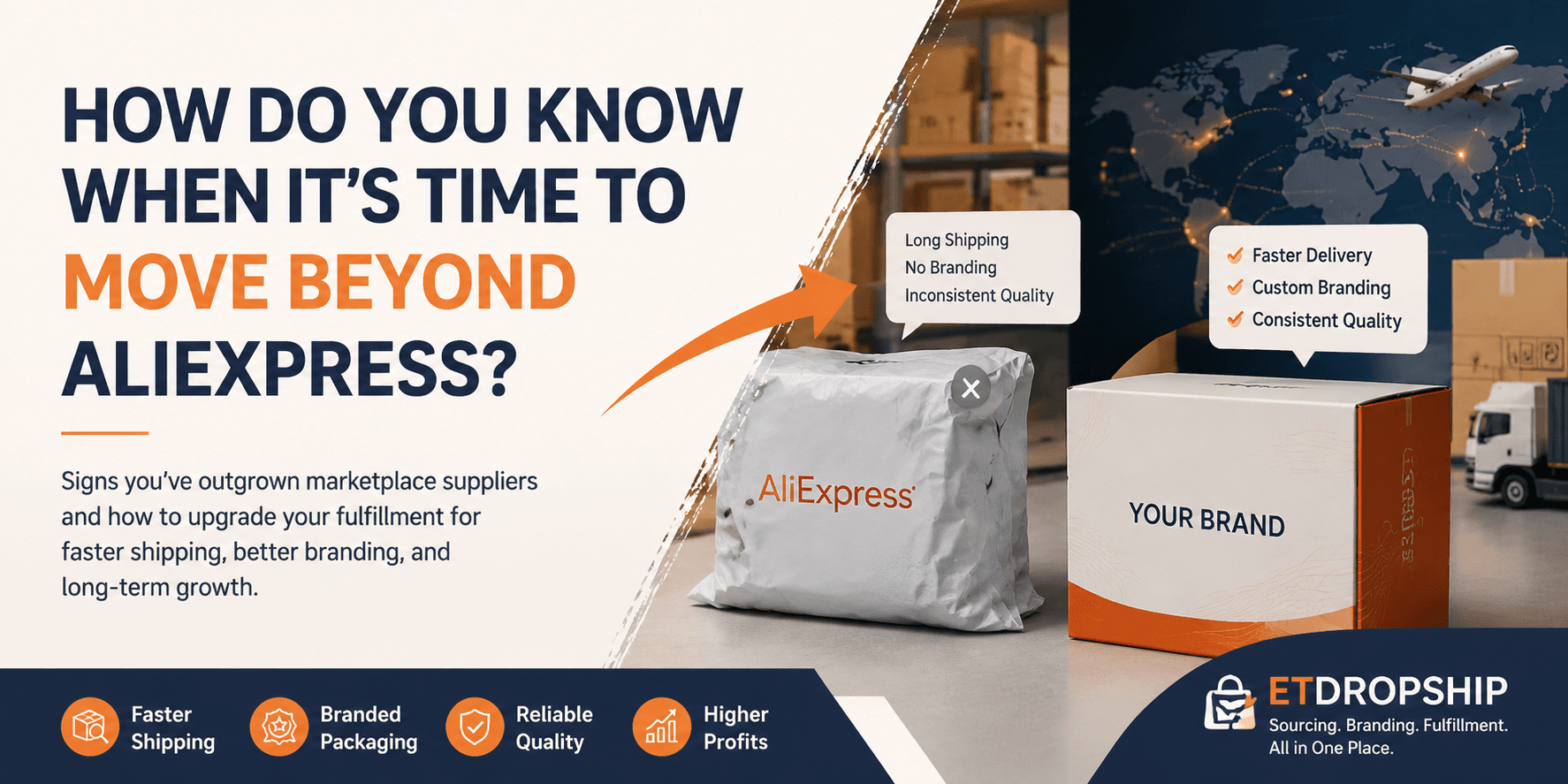
If you are reaching that stage, see our guide on when it’s time to move beyond AliExpress.
How to Choose the Right China Dropshipping Provider
The best provider depends less on which company has the longest feature list and more on the operational problem your store needs to solve.
For Beginners Testing Products
A beginner usually needs flexibility more than advanced supply-chain infrastructure. The ability to explore different dropshipping products, source them without large initial commitments, and process individual orders can be more valuable at this stage than building a complex supply chain too early.
At this stage, committing heavily to inventory or expensive custom packaging may create unnecessary risk. The first goal is to determine whether customers actually want the product.
For Growing Stores
Once products begin producing consistent sales, supplier reliability, processing speed, shipping stability, and quality control become more important.
This is often the point where sellers begin considering small amounts of inventory. Instead of purchasing each unit only after receiving an order, proven products can be stored in advance while new products continue to use an order-by-order model.
For Brands and Private-Label Sellers
Stores building a recognizable brand need to evaluate capabilities beyond basic fulfillment. Branding and product customization can extend from packaging, labels, and inserts to deeper product-level changes, while supplier communication and quality inspection help keep the final customer experience consistent.
However, branding does not need to begin with expensive fully customized packaging. It can be introduced gradually as order volume and product demand become more predictable.
Our private label dropshipping packaging guide explains how this transition can work.
For Higher-Volume Sellers
At higher order volumes, small operational inefficiencies become expensive. Manual order entry, inconsistent supplier processing, frequent stockouts, or a small defect rate can create significant problems when multiplied across hundreds of orders.
Higher-volume stores should therefore evaluate automation, inventory management, backup sourcing, warehouse capacity, quality-control processes, and logistics flexibility rather than focusing only on product sourcing. These priorities become especially important when a dropshipping supply chain scales from 20 to 500 orders per day, as processes that work at low volume may become operational bottlenecks as daily orders increase.
Compare Total Landed Cost, Not Just Product Price
One of the most common mistakes when comparing China dropshipping service providers is focusing only on the quoted product price.
Suppose Provider A can source a product for $8 while Provider B quotes $9.50. Provider A appears cheaper, but that conclusion changes if its shipping costs $7 while Provider B can ship the same product for $4.50.
The first option has a combined product and shipping cost of $15, while the second costs $14 before other applicable fees. The supposedly more expensive supplier actually produces the lower fulfillment cost.
The calculation can become more complex when packaging, fulfillment fees, customs, taxes, payment fees, refunds, and customer acquisition are included.
For this reason, the better comparison is usually total landed fulfillment cost for the target market rather than factory price alone.
Shipping also affects more than cost. A slightly more expensive logistics route may be worthwhile if it produces more predictable delivery, better tracking, and fewer customer-service problems.
Should You Source Directly From 1688?
1688 can provide access to a huge domestic Chinese supplier ecosystem and is often used by sourcing agents and experienced ecommerce businesses looking for products inside China.
However, the platform was primarily designed for the Chinese domestic market rather than international dropshipping. Language, supplier communication, domestic payments, minimum order quantities, quality inspection, and international fulfillment can therefore make direct sourcing more complicated for overseas sellers.
For businesses with sufficient experience or local support, 1688 can be a valuable sourcing channel. For other sellers, using a sourcing agent can simplify communication, procurement, inspection, and international fulfillment.
If 1688 is becoming part of your sourcing strategy, our guide to the top 1688 sourcing agents in China provides a dedicated comparison.
What Should You Ask Before Choosing a Provider?
Before committing significant order volume to any dropshipping provider, sellers should understand exactly how the service operates.
A few questions are especially useful:
How are products sourced and suppliers selected?
What happens when a product is out of stock?
Can products be inspected before fulfillment?
What shipping options are available for your main market?
Can the provider support branding or custom packaging?
How are lost, damaged, or incorrect orders handled?
You do not necessarily need the provider with the most services. You need one whose capabilities match your current business model and the direction in which you expect the store to grow.
Testing the service with a small number of orders before moving significant volume can also reveal information that a feature page cannot, including communication quality, processing speed, packaging, tracking reliability, and how problems are handled.
Common Mistakes When Choosing a China Dropshipping Provider
Choosing Only by Product Price
The lowest product quotation does not necessarily create the lowest total cost. Shipping, fulfillment, packaging, quality problems, and refunds can completely change the economics.
Ignoring the Target Market
A provider may have an excellent shipping solution for the United States but a less attractive option for another country. Compare the actual routes available for the markets where your customers live.
Scaling Before Testing the Supply Chain
A successful advertising campaign can become a problem if the supplier cannot maintain stock or process the resulting order volume. Before increasing marketing spend significantly, sellers should understand supplier capacity and fulfillment performance.
Adding Branding Too Early
Custom packaging can improve the customer experience, but purchasing large quantities before a product is validated increases risk. Branding is usually more sustainable when introduced progressively as sales become predictable.
Depending on One Supplier Without a Backup
Supplier problems are inevitable at some point. Production schedules change, materials become unavailable, prices increase, and products can be discontinued.
For important products, understanding alternative sourcing options can reduce the impact of these disruptions.
Frequently Asked Questions
What is a China dropshipping service provider?
A China dropshipping service provider helps ecommerce sellers source, process, and ship products from China. Depending on the provider, services may also include procurement, quality inspection, warehousing, branded packaging, store integration, and international fulfillment.
What is the difference between a China dropshipping agent and AliExpress?
AliExpress is primarily a marketplace where sellers work with individual suppliers. A dropshipping agent can coordinate sourcing, procurement, quality control, packaging, inventory, and fulfillment across multiple suppliers.
Do I need inventory to work with a China dropshipping provider?
Not necessarily. Some providers support order-by-order purchasing, allowing sellers to begin without holding significant inventory. Proven products can later be stocked when demand becomes more predictable.
Is 1688 better than AliExpress for dropshipping?
Neither is automatically better. AliExpress is easier for many international beginners, while 1688 can provide access to a broader domestic Chinese supplier ecosystem. However, sourcing directly from 1688 can require more support with communication, payment, quality control, and international fulfillment.
Should I choose the provider with the cheapest product price?
No. Compare total landed fulfillment cost, including the product, shipping, fulfillment, packaging, and other applicable costs. Product quality, processing speed, delivery reliability, and customer support should also influence the decision.
Can a China dropshipping provider help with branded packaging?
Many sourcing and fulfillment providers offer some form of branding, but capabilities and minimum quantities vary. Sellers should confirm the exact packaging requirements, costs, and MOQs before choosing a provider.
When should I move from AliExpress to a sourcing agent?
There is no universal order threshold. A sourcing agent becomes more useful when supplier management, quality consistency, stock availability, branding, product consolidation, or fulfillment complexity starts limiting the business.
Final Thoughts
There is no single best China dropshipping service provider for every ecommerce business. A beginner testing products, a growing Shopify store, a private-label brand, and a high-volume seller can all require very different supply-chain solutions.
Large platforms can make product discovery and initial fulfillment easier, while sourcing agents can provide more individualized supplier coordination. Fulfillment-focused providers become increasingly valuable when sellers begin holding inventory and need more consistent processing, packaging, and international shipping.
The most useful comparison is therefore not simply “Which provider is cheapest?” It is “Which provider best matches the way my business operates now and where I expect it to go next?”
Start by understanding your product, target market, expected order volume, branding requirements, and shipping expectations. Then compare actual quotations and service capabilities under the same conditions.
For new products, flexibility may matter most. As demand becomes predictable, supplier reliability, quality control, inventory management, branding, and fulfillment efficiency become increasingly important.
That transition—from simply finding products to building a reliable supply chain—is ultimately what determines whether a dropshipping operation can scale sustainably.
Disclosure: ETdropship is operated by the company publishing this article and is included as one of the providers above. The purpose of this guide is to compare different service models rather than claim that one provider is the best choice for every seller.